Thursday, 23 July 2015

Eat at your own risk

Eat at your own risk

Lab studies by Sapna Johnson, Ramakant Sahu and Poornima Saxena

Junk food is all about pleasure and empty calories. So, the world is worried. It is now linked to the growing epidemic of non-communicable diseases—the ‘fat’ problem. Every ailment from heart diseases to hypertension and diabetes is linked to how one eats and how one exercises. Junk food has become the world’s biggest health headache. And some governments are taking action—banning junk food advertising in children’s programmes, removing it from schools and even imposing a fat tax. Sugar, salt and fat are items that need to be regulated. This means governments have to step in to control the powerful processed food industry. But this is not happening in India. It believes food industry has full privilege to sell anything—and kill people slowly and sweetly. So, the Pollution Monitoring Laboratory of the Centre for Science and Environment, a non-profit in Delhi, decided to investigate the food people love to eat—everything from chips to bhujia and instant noodles to burgers. All the food that is sold to us through persuasive and glamorous advertisements; all the food that our film and cricket stars tell us to eat. The laboratory checked for fats, carbs, salt and trans fats. The results are deadly and damning. Eat at your own risk, is the message.

Fat of the matter
FRIED POTATO CHIPS
CHIPSIt has around 33% fats. This means if one munches a standard-sized packet of chips (65-75gm), he or she consumes about half of the daily fats quota. Unlike in a balanced diet, where a maximum of 30% of calories should come from fats, 50-60% of calories come from fats in chips
INDIAN SNACKS
aloo bhujiaFats and carbohydrates combined, 100 gm of Kurkure has enough calories to satisfy one-fourth of one’s daily recommended quota. If you are fond of aloo bhujia with tea, you get high doses of salt and trans fats, along with a high amount of calories
INSTANT NOODLES
Maggie NoodlesThe “tasty and healthy” meal comes with high salt, empty calories. A packet of noodle has around 3 gm of salt; recommended intake is 6 gm/day. Addition of vitamins, as claimed by Maggie Noodles, doesn’t make it a healthy food as it has negligible fibres; 70% of it is just carbohydrates
POTATO FRIES
POTATO FRIESFries that one eats with burger and soft drink are laden with fats: 20% of its weight is fats, 1.6% of its weight is trans fats. By eating a large serving (220 gm), one exceeds the safe limit for trans fats. Additional trans fats come from accompanying burger too
BURGER
BURGERKFC’s Chicken Zinger has 16.9% fats. McAloo has 8.3% fats. How unbalanced diets are they is gauged from the fact that 35% of calories in a veg burger come from fats. In non-veg burgers 47% calories are from fats
CARBONATED DRINKS
cold drinksThe 300 ml serving that one drinks with all kinds of junk food has enough sugar (over 40 gm) to exceed one’s daily sugar quota of 20 gm. After this, forget the cup of tea, one should not even eat fruits. Any additional sugar will make one fat
FRIED CHICKEN
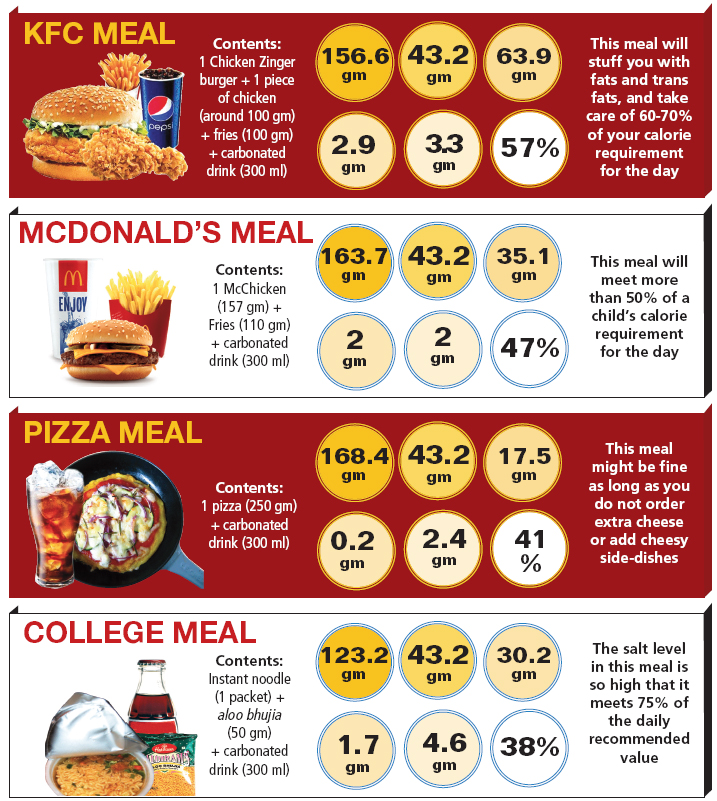
KFCRegular consumption of this product is likely to make one obese. A two-piece fried chicken of KFC (about 250gm) has nearly 60 gm of fats, which is recommended for the whole day
PIZZA
pizzaBy far, pizzas were found to be healthy compared to the other junk foods tested. They have low levels of salt and fats; levels of trans fats were also low. CSE tested only the basic pizza. Those with extra cheese are more popular and might not be very safe


Consumers duped

There is no proper definition for junk food. According to the Food Safety and Standards Act of 2006, foods like burgers, pizzas and chips fall under the category of “propriety or novel” food, for which standards have not been specified but they are not unsafe. So this category of foods declare their composition only broadly. Fast food giants take advantage of this provision to dupe consumers. Even though Food Safety and Standards Authority of India (FSSAI) mandates food companies to declare the information of the total energy, carbohydrates and sugars, proteins, fats and transfats on the product label, the study by the Centre for Science and Environment (CSE) reveals that the consumer has no way of knowing what he or she is eating.

Flouting norms: Haldiram Aloo Bhujia and Top Ramen instant noodles claim to be trans fats-free. But CSE study found they are not. As per FSSAI rules, a product can claim to be trans fats free if it contains less than 0.2 gm of trans fats per serving. As per the CSE study, a packet of Top Ramen instant noodles has 0.6 gm of trans fats; 100 gm of Haldiram Aloo Bhujia has 2.5 gm of trans fats. Though Haldiram claims its serving size is 10 gm, it is nothing but a gimmick. Consumption habit of people exceed this serving size and they end up consuming more trans fats.


Misleading claims: Many brands put misleading information about their trans fats content on the label. Products like Lay’s American Style Cream & Onion claim that they have “zero” trans fats in 100 grams of their products. However, CSE study found 0.9 gm trans fats in 100 gm of the product. Similarly brands like Haldiram Aloo Bhujia, Bingo Oye Pudina chips, Top Ramen noodles claim they have “zero trans fats” per 100 gm of product. But CSE results show otherwise.

No standardisation: Lay’s American Style Cream & Onion chips carries the nutritional information for both the serving size of 14 gm and 100 gm on its label. But Uncle Chipps Spicy Treat does not mention the nutritional information for a serving size. It just provides the nutritional data for 100 gm. Lack of nutritional information for a serving size leaves one with no scope for knowing how much calories he or she consumes.

Nutrition jugglery in claims: Till February this year, Frito Lay’s products claimed to be “smart snacks” because they used a healthy oil. At that time, the labels clearly mentioned that the products were trans fats-free. But from March onwards, the product ceased to be “trans fats free”. But this shift was never mentioned in advertising blitzs. When CSE tested Lay's American Style Cream & Onion chips, it found that 100 gm of the chips contained 0.9 gm of trans fats. With the shift to palm oil, it is difficult to know the level of trans fats in the chips currently available in the country.

No claims: The non-packaged junk foods in India give nutrition information on their websites, but there seems to be a double standard in the play. McDonalds, for instance, gives information on 22 nutritional attributes on its US website. This includes information on different types of fats and even information on the levels of trans fats in the product. On the other hand, McDonald’s website for India provides information only on six nutritional attributes. Most importantly, it fails to provide any information on trans fats. But the company at least provides information on portion sizes in India. Other companies do not even do that. Pizza Hut’s website for India is a case in point. The company’s website in the US provides 12 nutritional attributes of the product, including the serving size, and even trans fats. Its website for India provides only six attributes in the dining menu; it does not mention trans fats. Its delivery menu does not provide any nutritional information. KFC’s website in US also provides the information on 12 nutritional attributes including the serving size, types of fats, including transfats, and fibres. But its Indian website gives only four nutritional information.

Junk food villains

There are no bad foods, only bad diets. So say many nutritionists. What make junk foods so unhealthy are the high-levels of fats, salt, sugar and carbohydrates in them. This nutrition profile adds to obesity and our increasing non-communicable diseases (NCD) burden. The Public Health Foundation of India (PHFI), a non-profit in Delhi, finds that NCDs were responsible for more than half of all deaths in 2005 and by 2030 will be the reason behind two-thirds of all Indian deaths. The latest National Family Health Survey, conducted in 2005-06, shows at least one in every eight people is overweight or obese. In urban India at least one in every five people is obese. Obesity in women has increased by more than four per cent between 1998 and 2005. It is a salt, sugar and fat problem.


undefined
  •  
  •  
  •  
Salt: Current global salt consumption in diets is 9-12 grams per person per day. WHO wants this halved, which will bring down coronary heart disease and stroke by 18-25 per cent respectively. In India, consumption of salt ranges between five and 30 gm. But the challenge of hypertension is growing. Bad food is adding to this. Just consider: one packet of chips has 2 grams of salt: one-third of your daily quota.

Bad fats: It is agreed that 15 to 30 per cent of our daily calories should be from fats, with not more than 10 per cent from saturated fats; trans fats should contribute at one or 2 per cent. India is already known as the diabetes capital of the world; it is home to one-fifth of the world’s type-2 diabetes load. So fat is bad. But a KFC chicken combo-meal, sold so lovingly to people, exceeds their daily fat and trans fats quota. But they are not told.

Carbs and sugar: Bad, we know. But do we know that while the National Institute of Nutrition (NIN) recommends 20 grams of added sugar in Indian diets, one 300 ml bottle of Pepsi or Coca-Cola has 42 gm of added sugar. You have just blown up your daily sugar quota two times over.

Governments are waking up to this fat-salt-sugar-problem. Several countries, including Ireland, Mexico, United Arab Emirates, and several US and Canadian states, have banned sale of junk foods in and around schools. In 2008 the UK banned junk food advertisements during television programmes aimed at children under 16 years. In March this year, Scotland proposed to ban junk food ads in TV shows aired before 9 pm. Denmark and Hungary imposed a fat tax on junk food last year. The surcharge is levied on food items like butter, milk, cheese, pizza, meat, bacon, ice-cream and processed food if they contain more than 2.3 per cent saturated fat. In Canada, a food product can be labelled as “free of energy” if it provides less than 5 kilo calories per serving of stated size.

Still, all is not well in this fat world.

What India needs to do 


  • One, junk food industry targets children as present and future consumers. It is, therefore, important to ban junk foods from schools and places where children can have easy access to these foods.
  • Two, to prevent children from junk foods, the Advertising Standards Council of India has guidelines in place. For example, it says, “Caution and care should be observed in advertising of food and beverages especially ones containing relatively high levels of sugar, salt and fat” during television shows directed at children. Yet, there is hardly any restraint on advertisements. FSSAI should mandate advertising guidelines for these foods, including the time for airing of these advertisements (after 9 pm).
  • Three, FSSAI should come out with regulations to reduce salt, sugar and fats in junk foods. It should also follow the examples of Hungary and Denmark and impose “fat tax” on high-fat processed foods, making them expensive. This would dissuade consumers from such food.
  • Four, knowing the truth will help. The government should introduce mandatory labelling, at least for serving size, trans fats, saturated fats, sugar and salt, along with already mandatory nutritional information for all processed foods. This would help people make an informed choice. This should also be applicable to takeaway foods like pizzas and burgers. They should be asked to provide easy access to information on the wrappers/ boxes.
Then, may be, all will be well. 

Climate change causes species to change habitats

Climate change causes species to change habitats

Author(s): Kirtiman Awasthi

Birds have been hit the hardes

climate change is forcing plants and animals away from their native habitats to more congenial ones. A recent survey of plants in the uk found that species favouring higher temperature like orchids and ferns that used to be found in southern parts of the country are now flourishing in the north, too. Changes have been observed in populations and distribution of as many as one-third of all species since 1987, says the survey carried out by Plantlife International, a uk- based conservation organisation and the Botanical Society of British Isles.

Climate change such as warming up of atmosphere affects habitat (see table: Eco-effects), forcing plants and animals to disperse and migrate. But if a physical barrier prevents movement, then species could die out. "We are going to see a lot of extinctions, particularly of species that are not able to move quickly enough," says Katherine Stewart of Plantlife International.

Hardest hit Climate change has hit insects (like butterflies) and birds the hardest. Migratory birds that cover large distances have been unable to cope. The breeding period of birds usually synchronises with a time when food is available in plenty. But climate change has thrown this system out of gear. According to a study conducted at the Groningen University in the Netherlands, climate change has led to food shortages during the breeding period of several species, causing their populations to decline (Nature, Vol 411, No 6835, May 17, 2001).
RELATED SITE
 BBC: Climate change in-depth
• CSE: Fact about climate change
The State of uk 's Birds 2004 released last year (see ' uk birds hit', Down To Earth , September 30, 2005) said the numbers of some species considered secure were declining alarmingly. Seven of the nine common species of wading birds shifted from the 'warm west' to the 'colder east' in response to milder winters, the report said.

Climate change is affecting the seas, too. In the north Bering Sea, which is frozen for most of the year, the seasonal melt is starting earlier and there is less ice in general, says a us study ( Science, Vol 311, No 5766, March 10, 2006). This is causing grey whales to move farther north to follow the cold water, while animals like the walrus and sea birds are facing a food shortage. 

More disease A growing body of work is also linking climate change to the spread and re-emergence of certain human and animal diseases. 
Down to EarthPoor countries face a dramatic rise in deaths from disease and malnutrition as a direct result of climate change, says a study published in Nature (Vol 438, No 7066, November 17, 2005) .Increases in temperature and precipitation have facilitated the spread of vector-borne infectious diseases such as malaria and dengue in most developing countries in the tropical region. whosays that at least 30 diseases may be making a comeback in poor countries because of climate change.

A warmer climate is causing diseases such as the West Nile virus and malaria to spread to North America. The West Nile virus, which was unknown in North America until a decade ago, has infected more than 21,000 people in the us and Canada, killing more than 800.

Climate change models in the 1990s had predicted change in species distribution, habitat, emergence of new diseases and sea level rise -- all of which are coming true. In one of its worst effects, climate change altered patterns of a fungal infection, leading to the extinction of two-thirds of tropical harlequin frog species in Central and South America (Nature , Vol 439, No 7073, January 12, 2006). With the Australian Greenhouse Office recently claiming that global temperature will rise more than previous studies indicate, scientists say more extinctions seem inevitable.

EU nations agree to ban toxic chemical in textiles

EU nations agree to ban toxic chemical in textiles

Author(s): DTE Staff

Representational image (Credit: Fabrics for Freedom/Wikimedia Commons)
Surfactants used in textiles manufactured outside the EU are released into the environment when washed by consumers, posing risk to aquatic life
EU countries have unanimously voted to ban a toxic chemical used in the manufacturing of clothing and textile articles because it poses a risk to the environment, reports The Guardian.
In 2013, Sweden had proposed placing restrictions on textiles containing nonylphenols (NPs) and nonylphenol ethoxylates (NPEs), suspected for their endocrine disruptive properties and known to harm the aquatic environment. The proposal was supported by the European Chemicals Agency (ECHA).
In an information note based on Sweden’s report, ECHA states that when textiles containing NPs and NPEs are washed, the chemicals are released into the environment through waste water. The annual environmental release from textiles of NPs and NPEs and their derivatives is estimated at 257 tonnes in the EU, of which 2.5 per cent is released into surface water after treatment.
NPs and NPEs are used as surfactants in the manufacture of textiles outside the EU. The Guardian states that a report by Denmark’s environment agency found high concentrations of these chemicals in clothes manufactured in China and in brightly coloured clothes.
The EU has restricted the concentration of NPs and NPEs in textiles and other articles to under 0.1 per cent. Once adopted by the European Commission, the ban will enter into force in five years. According to the ECHA note, Sweden has argued that such a ban is “effective, practical and monitorable”. The ban is likely to affect, among others, big clothing brands with manufacturing units in other countries.
Manufacturers will be expected to adapt to the restriction and phase out clothing which could contain NPs and NPEs from EU markets over the five years.

Shell’s Arctic drilling support ship heads back to dock

Shell’s Arctic drilling support ship heads back to dock

Author(s): DTE Staff

Hole in the icebreaker vessel’s hull to be repaired at Oregon, US
Royal Dutch Shell PLC announced on July 13 that its icebreaker vessel MSV Fennica, which was crucial to the proposed Arctic drilling, will be sent to Oregon, US, for repair. A one metre by five centimeter gash was discovered on the ship’s hull on July 10 while it was on its way from Alaska’s Dutch Harbour port to the Chukchi Sea.
The incident, however, would not delay the drilling which is scheduled to start later this month. International media reports quote Shell spokesperson Curtis as having said that the ship was not needed until August.
Earlier this month, US’ Bureau of Ocean Energy Management had approved Shell’s oil exploration project in the Chukchi Sea, a minor sea in the Arctic Ocean, off the coast of Alaska.
The Arctic region is one of the richest fossil basins on the planet. Shell’s drilling plans are expected to pave way for other countries’ exploration initiatives in the region and environmentalists across the globe have protested against the multinational’s oil and gas exploration bid.
“The US government’s own analysis estimates that there’s a 75 per cent chance of a large oil spill if Shell is able to successfully extract oil from the Arctic. And industry experts say this would be virtually impossible to clean up,” says a report on the website of Greenpeace.

African economies to grow by 4.5 per cent in 2015

African economies to grow by 4.5 per cent in 2015

Author(s): DTE Staff


Modernising local economies will be the key to improving living standard of the people, says report


Poverty rates still remain high in Africa and progress in health, education and income is uneven (Credit: Magharebia/Flickr)


Africa’s gross domestic product (GDP) will grow by 4.5 per cent in 2015 and may reach 5 per cent in 2016, but modernising local economies will be the key to improving living standard of the people in Africa, says the African Economic Outlook 2015.

The report, prepared by the Organization for Economic Cooperation and Development, the African Development Bank and the United Nations Development Programme, was released on May 25. 

According to the report, “the rapid growth of Africa’s workforce will increase the pressure on labour markets. The workforce is expected to increase by 910 million people between 2010 and 2050, of which 830 million in sub-Saharan Africa and 80 million in North Africa. Creating more productive jobs, a major stake in Africa’s structural transformation, becomes even more pressing.”

Human development levels in the continent have increased since 2000, with 17 of 52 countries reaching middle or high levels of development. But poverty rates remain high and progress in health, education and income is uneven, the report says.

It adds that there is a need to focus on strengthening skills and education, addressing exclusion through the development of targeted social protection measures, and promoting universal access to sustainable energy and technology.

CURRENT AFFAIRS July/23/2015


CURRENT AFFAIRS July/23/2015

1.  INTEREST SUBVENTION SCHEME TO BANKS:
i.    Union Government extended Interest subvention scheme to banks.
ii.  The scheme is extended to ensure availability of crop loans of up to 3 lakh to farmers at 7 % per annual.
iii. Additional interest subvention of 3% per annum for those farmers who repay on time.
Note: The scheme is extended to public Sector banks, private sector commercial banks , rural regional banks, cooperative banks and NABARD.

2.  SURAKSHIT KHADYA ABHIYAN:
i. Union Government launched surakshit Khadya Abhiyan
ii.  Union Minister of consumer Affairs, Food and Public Distribution Ram Vilas Paswan launched the Abhiyan.
iii. Surakshit Khadya Abhiyan , a countrywide campaign, to create mass awareness and capacity building for safe and hygienicfood.

3.  INDIA AND SINGAPORE SIGNED MARITIME COOPERATION AGREEMENTS:
i.  India and Singapore have signed an agreement to enhance maritime cooperation.
ii.  The technical agreement on sharing white-shipping information between the two Navies.
iii.  The Singapore Navy and the Indian Navy conduct the Singapore-India Maritime Bilateral Exercise (SINBEX) together annually.
About Singapore –
           Capital – Singapore
           Currency – Singapore Dollar
           Prime Minister – Lee Hsien Loong

4.  ANANTH NARAYANAN BECOMES CEO OF MYNTRA:
i.  Ananth Narayanan is appointed as Chief Executive Officer of Myntra.


ii.  He will succeed Myntra’s Co-founder Mukesh Bansal.

CURRENT AFFAIRS July/22/2015


CURRENT AFFAIRS July/22/2015

1.  MAURIC OBSTFELD BECOMES CHIEF ECONOMIST OF IMF:
i.   Maurice Obstfeld of USA is appointed as Chief Economist of IMF.
ii.  Maurice Onstfeld will succeed outgoing IMF Economist Oliver Blanchard
IMF – International Monetary Fund
Head Quarter – Washington DC ,USA
Member – 188 countries

2.  IMPORTANT APPOINTMENTS:
Name
Appointed as
Replaced
Bhanu Pratap Sharma
Chairperson of ISSAI
Was handling additional charge until now.
Pankaj Munjal
CMD of Hero Motors
O.P.Munjal
CMD- Chairman and Managing Director
FSSAI- Food Safety and Standards Authority of India

3.  DRISHTI, INSTALLED AT IGI AIRPORT:
i. Indigenous visibility Measuring System, DRISHTI, installed at IGI Airport.
ii. The CAT III B IGI Airport, New Delhi, is now the first airport in the country to have 10 indigenous systems operating in all its three runways.
iii.  Drishti System is very cost effective and is a Mandatory System required at all airports as per International Civil Aviation Organisation (ICAO) and World Meteorological Organisation (WMO).

4. PAMARTHY SHANKAR WON GRAND PRIX WORLD PRESS CARTOON 2014 AWARD:
i. Telugu Cartoonist Pamarth Shankar won Grand Prix World Press Cartoon 2014 Award.
ii.  Pamarth Shankar won the award for sketching Nelson Mandela.

5.  INDIAN RAILWAYS AND ODISHA GOVERNMENT SIGNED MOU:
i.  An MoU is signed between Indian Railways and Odisha Government for Dasappla-Balangir Railway line.


ii.  The agreement was signed by Ved Parkash Dudija ,Executive Director (works) Ministry of Railways and Sanjay Rastogi, commissioner-cum-secretary, Commerce and Transport Department, Odisha Government.

CURRENT AFFAIRS July/20 & 21/2015


CURRENT AFFAIRS July/20 & 21/2015

1.  INDIA, MYANMAR ISSUED JOINT STATEMENT ON BILATERAL CO-OPERATION:
i.   India and Myanmar have issued joint statement on bilateral co-operation at Joint consultative   Commission (JCC) in New Delhi.
ii.  The JCC meeting was co-chaired by the External Affairs Minister Sushma Swaraj and the    Foreign Minister of Myanmar U Wunna Maung Lwin.
iii.   The Second JCC meeting is scheduled to be held in Myanmar in 2016.

2. PRASHANT PATHRABE BECOMES AS INTERIMDIRECTOR OF FILM AND TELEVISION INSTITUTE OF INDIA:
i.    Prashant Pathrabe appointed as Interim Director of Film and Television Institute of India.
ii.   Prashant Pathrabe succeeded incumbent Director D J Narain
iii. Prashant Pathrabe is Maharashtra-based senior Indian Information Sevice (IIS) officer of 1992 batch.

3.  NELSON MANDELA INTERNATIONAL DAY OBSERVED ON 18TH JULY:
i.   Nelson Mandela International Day was observed on 18th July 2015 across the world.
ii. The objective of the Mandela Day is to inspire individuals to take action to help change the world for the better.
iii. For the first time the day was celebrated on 18th July 2010 as per a UN General Assembly resolution of November 2009.

4.  FIRST ‘AAM AADMI CLINIC’ AT PEERAGARHI RELEIF CAMP:
i.    Delhi Chief Minister Arvind Kejriwal on 19th July, 2015 inaugurated the first ‘Aam Aadmi Clinic’ at Peeragarhi Relief Camp.

ii.   The Clinic is aimed at providing better medical facility to the weaker section.

CURRENT AFFAIRS July/18 & 19/2015

CURRENT AFFAIRS July/18 & 19/2015

1.  RBI SIGNED CURRENCY SWAP AGREEMENT WITH SRI LANKA:
i.   RBI has signed Currency Swap Agreement with the Central Bank of Sri Lanka
ii.  According to the agreement , the Central Bank of Sri Lanka can draw upto 1.1 billion US Dollar for a maximum period of 6months.

2.  ANDHRA PRADESH DISASTER RECOVERY PROJECT:
i.   India and World Bank have signed financing agreement for Andhra Pradesh Disaster Recovery Project.
ii.   India and World Bank have signed an agreement for assistance of 250 million US Dollars.

3.  CBS-ENABLED CO-OPERATIVE BANKS TO ISSUE ATM CARDS:
i. RBI has permitted CBS-enabled Cooperative Banks to issue ATM Cards in tie-up with a Sponsor Bank.
ii. By virtue of being a sub-member of National Financial Switch (NFS) are required to fulfill the risk management requirements prescribed by the sponsor bank.
CBS- Core Banking Solution

4.  SUNITA VISHWANATH HONOURED AS CHAMPIONS OF CHANGE:
i.   Indian American Sunita Vishwanath is honored as Champions of Change by US White House.
ii.  Sunita is selected for her work to encourage Hindus to take care of the Environment.
iii. Sunita Vishwanath is among 12 other faith leaders who are awarded for the efforts in protecting Environment and communities from the effects of climate change.
Note: Sunita Vishwanath is co-founder and active board member of the 14 year old front line women’s human rights organization.

5.  WHITE-FI TECHNOLOGY TO BOAST DIGITAL INDIAINITIATIVE:
i.  White-fi technology of Microsoft is set to boost Digital IndiaInitiative
ii. White-fi technology of TV White Space Technology uses unspent spectrum on TV for internet usage.

6.  INS ASTRAVAHINI DECOMMISSIONED:
i.   INS Astravahini decommissioned after 31 years of service.
ii.  INS Astravahini is indigenously built Torpedo launch and Recovery Vessel (TLRV)